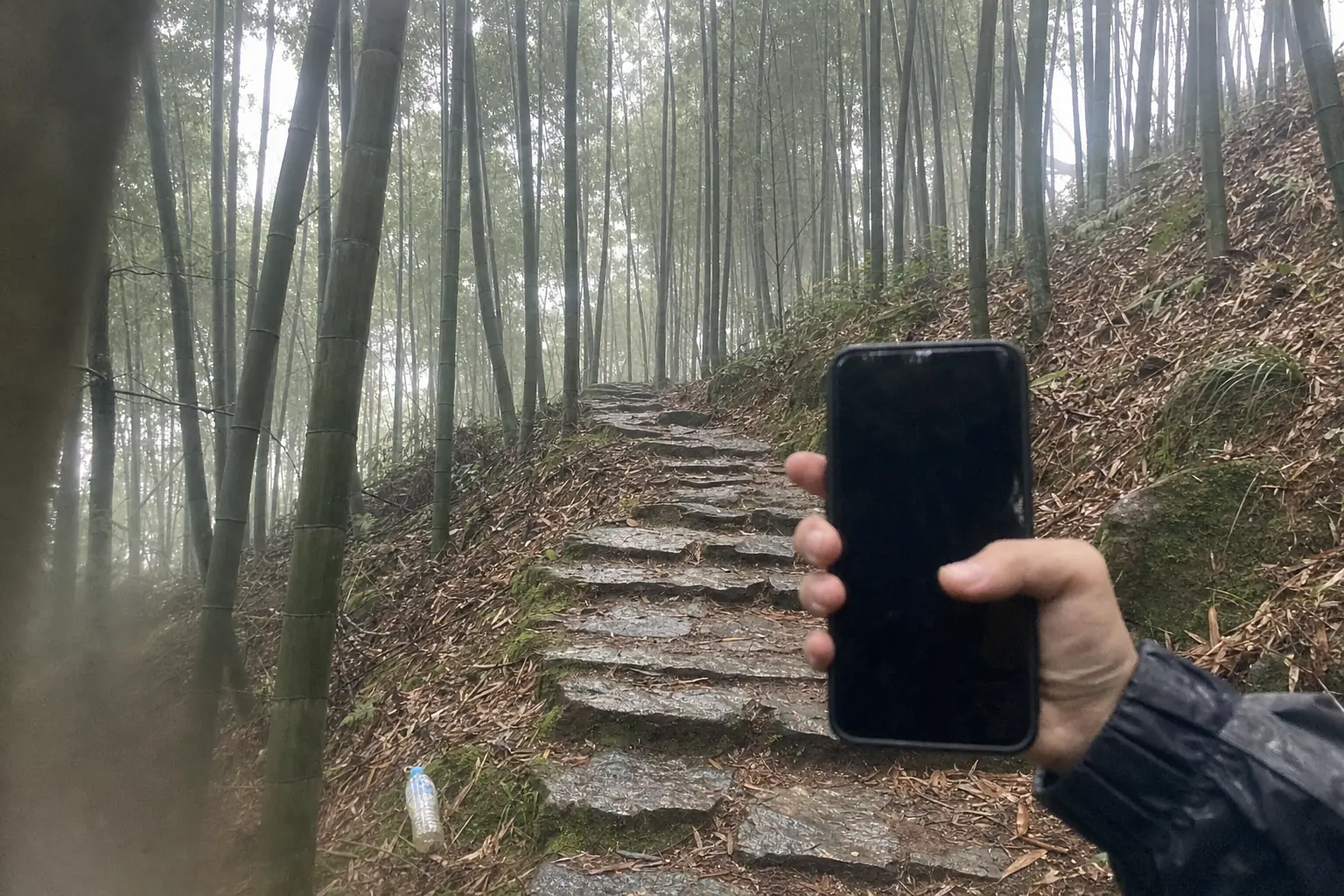
Most visitors start with the wrong question. They ask which VPN to buy before they fly. The question that decides whether your maps and messages open on Moganshan is a different one: which network is carrying your data. A roaming SIM from home, or a China eSIM bought from a travel provider, usually sends your traffic back through your home operator before it reaches the internet. A Chinese SIM card does not.
Moganshan (莫干山) is a mountain in Deqing County (德清县), Huzhou (湖州), Zhejiang (浙江), about 60 km north of Hangzhou and 200 to 240 km from Shanghai. Moganshan Road in Shanghai, the M50 art district, is a different place. Paying with your phone is in paying for things on Moganshan.
The four ways to get online
| Option | How you get it | Where your data leaves | The catch |
|---|---|---|---|
| Roaming on your home SIM | Switch it on at home | Usually your home network | Your home operator’s daily price |
| A travel eSIM for China | Bought online before you fly | Depends on the provider: ask | Check the routing before you pay |
| A Chinese SIM card | Passport, in person, at an operator’s own shop | Inside China | Connects inside China, under Chinese rules |
| Wifi in your room | The guesthouse or hotel | Inside China | Sign in rules vary; ask at reception |
No prices here. Roaming and travel eSIM prices come only from the sellers themselves, and we do not quote a seller as a source.
How a China eSIM or roaming SIM carries your data
Mobile networks give a roaming phone two ways out. In one, called home routed, your data travels from the local mast back to your home operator and leaves for the internet from there. In the other, local breakout, it leaves straight from the network you are visiting. The mobile operators’ association describes both in its roaming guidelines.
Two roaming models, Local Breakout and Home Routed, GSMA NG.113 5GS Roaming Guidelines, version 11.0, October 2024, tier 1. https://www.gsma.com/newsroom/wp-content/uploads/NG.113.v.11.0.pdf
Which one your plan uses is the thing to find out. With home routing, the sites you reach see a connection from your own country. That is why people roaming on foreign cards report their usual sites opening without a VPN. In July 2025 a user of a Chinese language forum based in the United States asked whether an American prepaid SIM roaming in China would reach American websites. The replies said yes: roaming traffic goes home first.
A US prepaid SIM roaming in China reaching US sites, post by Delltv and replies, US Card Forum (美卡论坛), 13 and 14 July 2025, tier 3. https://www.uscardforum.com/t/topic/413548
Mainland users describe the mirror image. In a 2023 thread, mainland users said their own cards route home from abroad (归属地接入, home routing), unless they buy local data.
Roaming routed through the home operator, local data not, thread by liufuyi and replies, V2EX, 25 and 26 September 2023, tier 3. https://www.v2ex.com/t/977077
Those are forum reports, not a guarantee. Travel eSIMs are sold by resellers, and some break out locally. Before you pay, ask the provider in writing where its data exits for a trip to the Chinese mainland. If the answer is a Chinese network, plan as if you had a Chinese SIM.
A Chinese SIM card: a passport and a counter
The rules for a local card are strict. Bring your passport (or a foreign permanent residence card) to a shop run by one of the operators themselves: China Telecom (中国电信), China Mobile (中国移动), China Unicom (中国联通) or China Broadnet (中国广电). A reseller’s kiosk will not do. You apply in person.
SIM cards for foreigners with a passport or permanent residence card at the operators’ own halls, packages bundling calls and data, Ministry of Commerce (商务部) with other departments, Guide for foreign business people in China, 2024 edition, Chinese embassy copy, 10 April 2024, tier 1. https://ss.china-embassy.gov.cn/lsfw/dsdnflxbd/202404/t20240410_11279344.htm
Two details catch people out. Your phone has to support 5G or VoLTE (voice over 4G), and each operator caps you at five numbers nationwide.
Own halls only, the holder in person, a 5G or VoLTE phone, at most five numbers per operator nationwide, hotlines 10000, 10086 and 10010, Tianjin Communications Administration (天津市通信管理局), 14 April 2026, tier 1. https://tjca.miit.gov.cn/bsfw/bszn/art/2026/art_4cdc69ee883e409990033d44b49e0fab.html
To find a branch the operator runs itself, ring 10000 (China Telecom), 10086 (China Mobile) or 10010 (China Unicom), or use its app. Do it in Shanghai or Hangzhou, not on the mountain.
A Chinese card is the right choice for a long stay, for a Chinese number that apps and guesthouses can text, or when your home roaming is expensive. It is the wrong one if you want your home apps to behave as they do at home: a local card connects you inside China, under Chinese rules.
The domestic eSIM is not for visitors yet
China’s own operators began selling eSIMs for phones in October 2025. Opening one still means a visit to a hall.
eSIM phone service on sale nationwide from China Telecom, China Mobile and China Unicom, opened at a hall or booked in the app and finished at a hall, Xinhua (新华网), 14 October 2025, tier 2. http://www.news.cn/tech/20251014/8a25d52bf5594e36aa812f93e2deec35/c.html
When China Mobile opened bookings in September 2025, it said overseas users were not supported for now, along with minors and anyone applying for someone else. We found no later announcement opening it to visitors, as of 20 October 2026. For a visitor, a China eSIM still means a travel eSIM bought abroad.
China Mobile eSIM bookings, holder in person with an ID card, minors, overseas users (境外用户) and agents not supported for now, Jingchu Net (荆楚网), 21 September 2025, tier 2. https://www.ctdsb.net/c1666_202509/2542773.html
What the VPN rule says
The rule is written down. In January 2017 the Ministry of Industry and Information Technology (MIIT) said that without approval nobody may set up or rent lines, VPNs included, to carry out cross border business.
No self built or rented lines, VPNs included, for cross border operations without approval, MIIT notice 工信部信管函〔2017〕32号 of 17 January 2017, published by the Cyberspace Administration of China (中央网信办), 23 January 2017, tier 1. https://www.cac.gov.cn/2017-01/23/c_1120366809.htm
A day later the ministry added that foreign trade firms and multinationals needing cross border links for office use could lease them from licensed carriers. Nothing in either text speaks to a tourist’s phone.
Licensed carriers for companies’ office use, MIIT clarification reported by China News Service (中国新闻网), 24 January 2017, tier 2. https://www.chinanews.com.cn/m/cj/2017/01-24/8134818.shtml
We do not advise on VPNs and do not recommend one. The practical point is simpler: a visitor whose roaming plan or travel eSIM routes home has nothing to decide. For them the VPN question on Moganshan doesn’t arise.
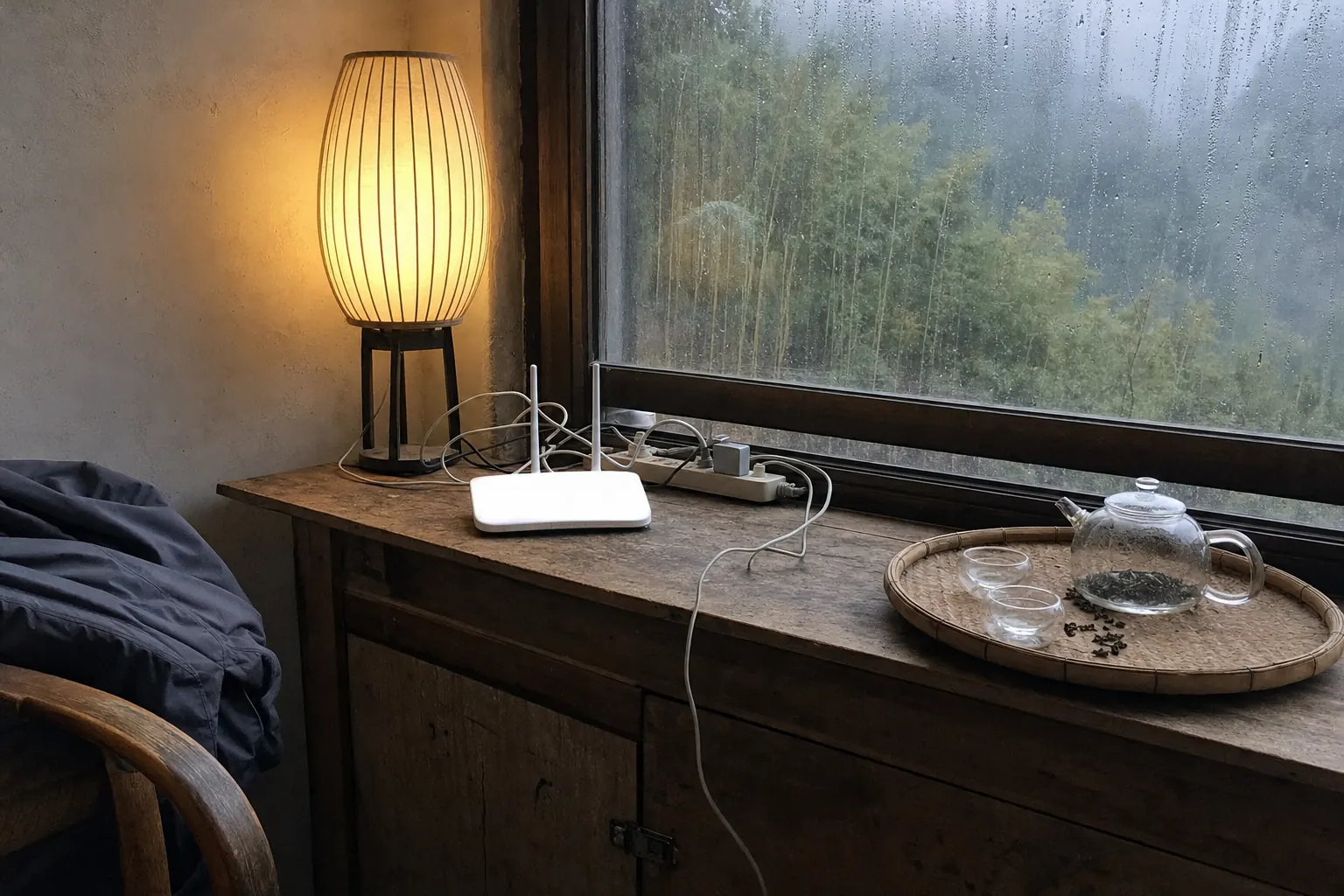
Guesthouse and hotel wifi
The wifi in your room is a Chinese connection. China’s Cybersecurity Law (网络安全法) requires whoever provides network access to take your real identity when you sign up. Since the amendment of 28 October 2025 that duty sits in Article 26.
Network access and mobile registration only against real identity information, Cybersecurity Law as amended on 28 October 2025, Article 26, Cyberspace Administration of China, 29 December 2025, tier 1. https://www.cac.gov.cn/2025-12/29/c_1768735112911946.htm
We have found no published rule on how a foreign guest signs in. Ask at reception when you check in. The county said in 2020 that it had wifi across its 4A rated scenic areas (the national A rating runs from 1A to 5A), with the Moganshan resort among the places it named for smart visitor services.
Wifi across 4A scenic areas, 5G across the main town by end 2019 and the whole county as the 2020 aim, Zhejiang Online (浙江在线), 2 March 2020, tier 2. https://zjnews.zjol.com.cn/zjnews/huzhounews/202003/t20200302_11730781.shtml
That is a claim about the scenic areas, made in 2020. It says nothing about the room you sleep in.
Signal on the mountain: what is written down
Here the record runs thin. We won’t fill it with a guess. Nobody has published a signal map of the scenic area. The county’s 2020 aim was 5G everywhere in Deqing, and nobody has published whether it was met. Steep wooded valleys weaken mobile signal anywhere, and nothing published shows Moganshan is an exception.
One dated account helps. A walking group leader who took the Chiang Kai-shek path loop in October 2023 noted a phone signal inside the scenic area.
Phone signal inside the scenic area on the Chiang path loop, Youxiake (游侠客) community, group leader 佩琪, October 2023, tier 3. https://bbs.youxiake.com/y/1053344.html
That is one route on one day. Download an offline map of the mountain before you leave the hotel. Screenshot the booking and the ticket too, and note the way back to the transfer centre. The Chiang Kai-shek path is the walk where that matters most.

When the phone or the signal fails
A shop on a quiet lane is no place to find out your payment app has no data, so carry some cash. It is still accepted, as money and payments explains. Learn the three emergency numbers before you go. Police is 110, fire 119 and ambulance 120.
Emergency numbers 110 for police, 119 for fire, 120 for ambulance, Ministry of Commerce (商务部) with other departments, Guide for foreign business people in China, 10 April 2024, tier 1. https://ss.china-embassy.gov.cn/lsfw/dsdnflxbd/202404/t20240410_11279344.htm
Other questions are answered on the plan your trip FAQ and under plan your trip.
Last checked 21 October 2026 by Cyril Drouin. Prices, timetables and entry rules on this mountain move without notice, so confirm anything you are booking around.
Photographs on this site are representative illustrations, not documentary images of the specific building, property or service described.