Search for Mogan Huangya in English and the first page is mostly tea shops selling a rare yellow tea. Rare, yes. It’s the yellow that needs correcting. On the county’s own account, most tea sold under this name since the 1990s has been made as a green tea, and growers have only lately gone back to making it yellow in any quantity.
Five of the first nine English results for “Mogan Huangya” were tea retailers or a tea review site, BeyondBorder Group Ltd desk research, 17 October 2026.
So the name tells you a place and a pick. It does not tell you what is in the packet.
Mogan Huangya (莫干黄芽, “Mogan yellow bud”) is the tea of Moganshan (莫干山), the bamboo mountain and former hill station in Deqing County (德清县), Huzhou (湖州), Zhejiang, about 60 km north of Hangzhou and 200 to 240 km from Shanghai. It has nothing to do with Moganshan Road in Shanghai, the M50 art district, which owns the search results for the mountain’s name. Our page on Moganshan yellow bud tea explains yellow tea as a class and how to get a cup at a guesthouse. This one is about the tea itself.
Yellow or green: what the name does not tell you
The tea was revived as a yellow one. In spring 1979 a team under Zhang Tangheng (张堂恒), a tea professor at Zhejiang Agricultural University, made trial batches on the mountain. In May 1982 Zhejiang put it on its first list of provincial named teas, third after West Lake Longjing and Jingshan.
Then the market turned it green. Yellow tea looks yellow in the packet and in the cup, and buyers who came in summer or autumn took it for old, stale tea. Makers dropped the yellowing step. From the 1990s most Mogan Huangya on sale was the green version.
The 1979 trials, the 1982 listing and the switch to green, Deqing County Agriculture and Rural Affairs Bureau (德清县农业农村局), 4 September 2019, tier 2. https://www.sohu.com/a/338796221_99901975
It mostly still is. In September 2026 Deqing News reported that the tea circulates mainly in its green form, and that yellow is a sliver of the market few buyers recognise. The local contest shows the split: in April 2024 the judges took 15 yellow samples and 14 green ones, and gave gold awards in both classes.
Mainly green, Deqing News (德清新闻网), 22 September 2026, tier 2. https://dqnews.zjol.com.cn/dqnews/system/2026/09/22/035296333.shtml; the 2024 samples, Deqing News (德清新闻网), 15 April 2024, tier 2. http://dqnews.zjol.com.cn/dqnews/system/2024/04/15/034592331.shtml
Neither version is a fake. Each has its own standard, a national industry one for the yellow (GH/T 1235, 2018) and a local one for the green (2019). The agriculture bureau describes them like this.
| Yellow version (黄茶) | Green version (绿茶) | |
|---|---|---|
| Dry leaf | Tight, slightly curled, pale yellow, downy | Tight, glossy green, downy |
| Liquor | Pale yellow, bright | Pale green, bright |
| Aroma | Clear and sweet | Tender, lasting |
| Taste | Sweet and mellow | Fresh and brisk, then sweet |
The two standards and the descriptions, Deqing County Agriculture and Rural Affairs Bureau (德清县农业农村局), 4 September 2019, tier 2. https://www.sohu.com/a/338796221_99901975
A shop abroad that promises a fresh, grassy cup may simply be selling the green one. Ask which is in the bag. In Chinese the word to look for is the class: 黄茶 for yellow, 绿茶 for green.
How Mogan Huangya is made
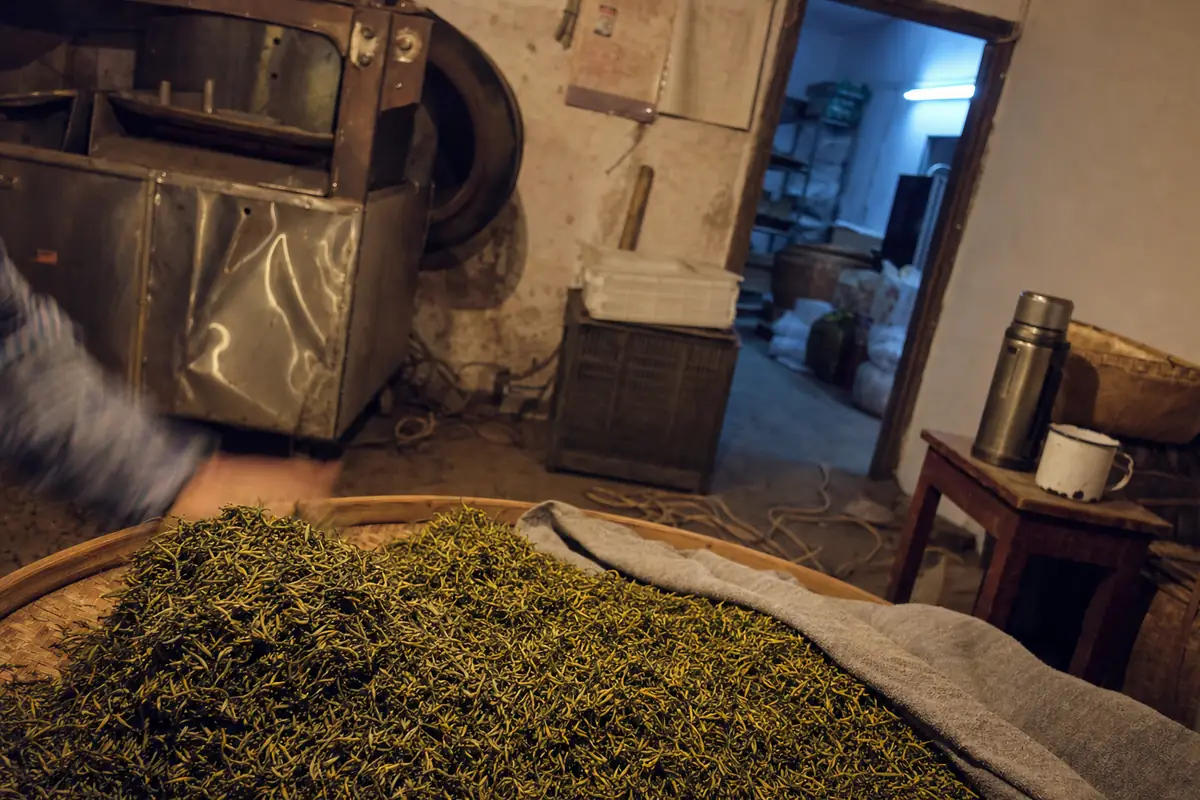
China Quality News lists the steps for the yellow version as fixing (杀青), the heat that stops the leaf oxidising; rolling (揉捻); yellowing (闷黄); a first drying (初烘); shaping (理条); and a final drying (足干). The green version leaves out the yellowing.
That step is the whole difference, and the slow one. The leaf is held warm and damp so it yellows a little before it dries. Shen Yunhe (沈云鹤), named a provincial heritage bearer for the craft in 2026, told Deqing News it often runs to tens of hours and is judged by experience. Another maker, Wang Shiyan (王仕彦), told China Quality News that a heavier yellowing gives a sweeter, softer cup that more drinkers take to.
The steps and the heavier yellowing, China Quality News (中国质量新闻网), 28 May 2024, tier 2. https://www.cqn.com.cn/zj/content/2024-05/28/content_9051912.htm; Shen Yunhe, Deqing News (德清新闻网), 22 September 2026, tier 2. https://dqnews.zjol.com.cn/dqnews/system/2026/09/22/035296333.shtml
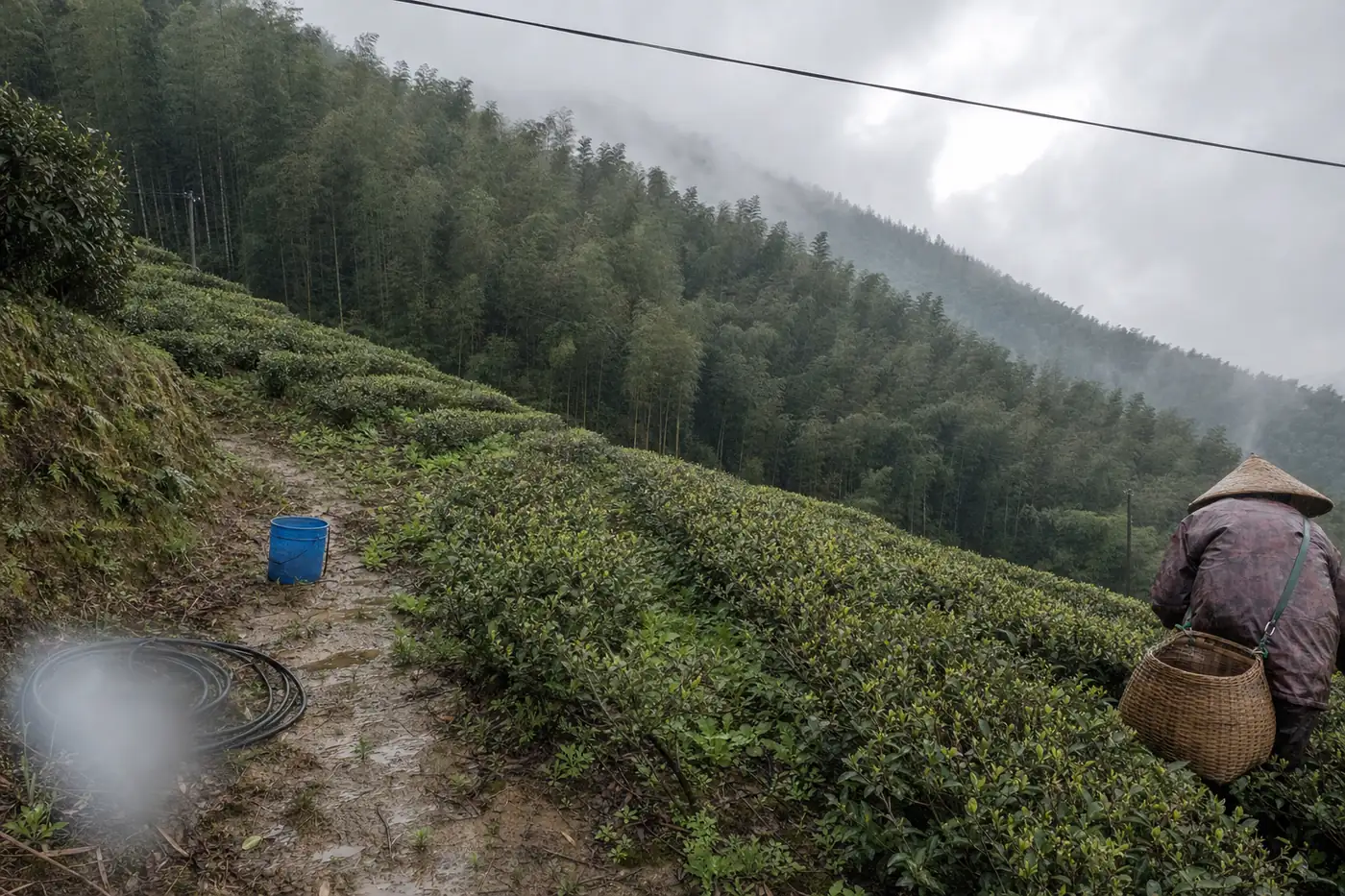
The leaf does not come from one bush. Shuangfeng (双丰), one of the first gardens picked in 2026, grows more than ten cultivars, among them Longjing 43 (龙井43号) and Yingshuang (迎霜).
The cultivars at Shuangfeng, Deqing News (德清新闻网), 17 March 2026, tier 2. https://dqnews.zjol.com.cn/dqnews/system/2026/03/17/035174990.shtml
Where it comes from, as the record tells it
Deqing dates tea on these hills back nearly 2,000 years, to Jin dynasty monks, and points to a line in Lu Yu’s Classic of Tea (茶经) placing tea in the valleys of Wukang (武康), the county’s old name. A Qing text, Tang Jing’s (唐靖) Qianxi Yizhi (前溪逸志), gives the method in four words, 炙 挼 焙 汰: heating, rubbing, drying, sorting. The 2,000 years is the county’s figure; we found nothing that dates it more closely.
The modern record is firmer. The name became a registered trademark in 2009. A Zhejiang University team began refining and mechanising the yellowing in 2013, by Xinhua’s account, or after 2014 in the bureau’s. The tea became a national geographical indication in December 2017, and its making technique joined Zhejiang’s intangible heritage list in 2023.
Nearly 2,000 years, the Qing method and 2013, Xinhua (新华网), 20 April 2023, tier 2. http://www.news.cn/local/2023-04/20/c_1129543397.htm; the trademark, 2014 and the indication, Deqing County Agriculture and Rural Affairs Bureau (德清县农业农村局), 4 September 2019, tier 2. https://www.sohu.com/a/338796221_99901975; the heritage listing, Deqing News (德清新闻网), 22 September 2026, tier 2. https://dqnews.zjol.com.cn/dqnews/system/2026/09/22/035296333.shtml
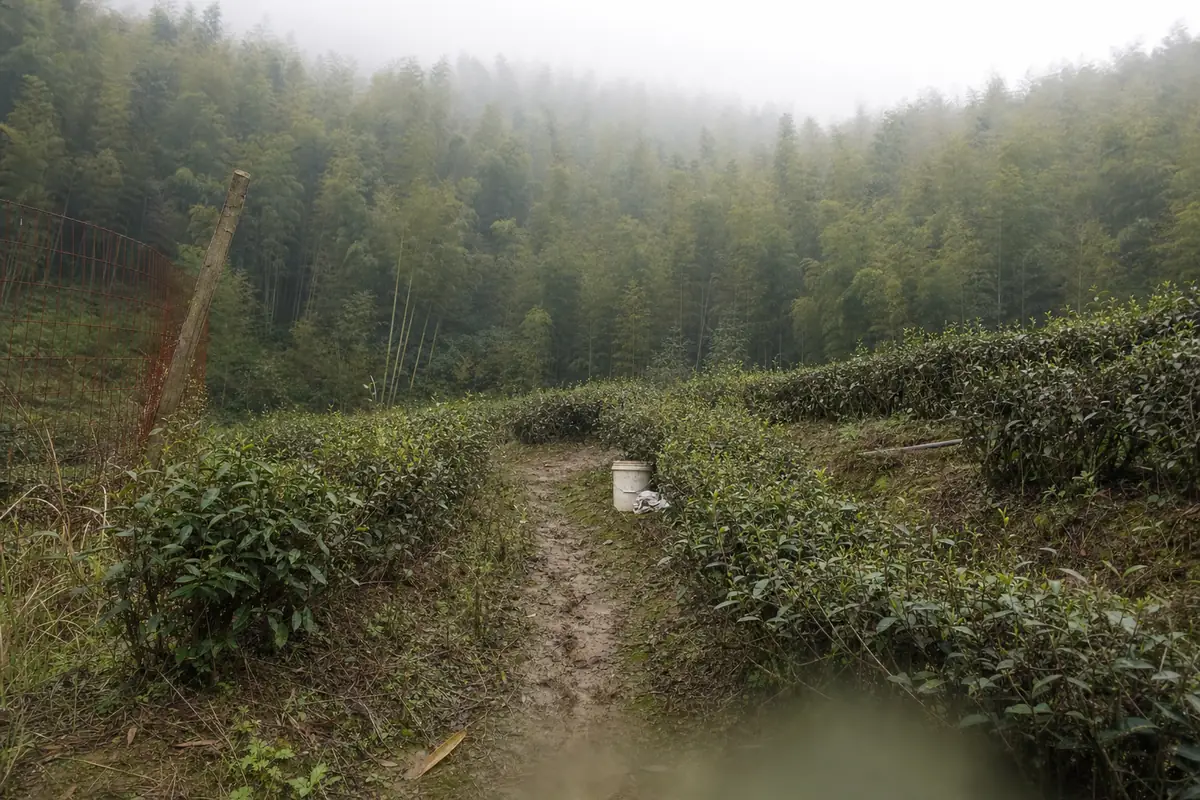
For a buyer, the indication matters more than the history. It covers 26 villages in Moganshan town and three subdistricts of the county town, Wukang, Wuyang and Fuxi. Mogan Huangya does not have to grow on the mountain. When the 2026 season opened on 15 March, Deqing News reported it from a garden in Minjin village (民进村), in Fuxi, on the eastern edge of the zone.
The zone and its eastern boundary, Deqing County Agriculture and Rural Affairs Bureau (德清县农业农村局), 4 September 2019, tier 2. https://www.sohu.com/a/338796221_99901975; the season’s opening, Deqing News (德清新闻网), 17 March 2026, tier 2. https://dqnews.zjol.com.cn/dqnews/system/2026/03/17/035174990.shtml
How much there is, and why the figures disagree
It is a small tea, and the sources disagree on how small.
| Year | Planted area | Output | Source |
|---|---|---|---|
| 2017 | 25,000 mu, about 1,670 ha | not given | China News Service |
| 2022 | about 24,000 mu, about 1,600 ha | 1,280 t, all tea in Deqing | Xinhua |
| 2024 | 1,053 ha, about 15,800 mu | 600 t | China Quality News |
A mu (亩) is a fifteenth of a hectare; the conversions are ours. The 2024 report does not say what its 600 t covers, and none of the three gives a yellow share. One figure points the way. Wang Shiyan’s company took 40 percent more orders for its yellow tea than a year earlier, though still fewer than for its green.
2017, China News Service (中国新闻网), 15 April 2018, tier 2. https://www.chinanews.com.cn/m/cj/2018/04-15/8491576.shtml; 2022, Xinhua (新华网), 20 April 2023, tier 2. http://www.news.cn/local/2023-04/20/c_1129543397.htm; 2024, China Quality News (中国质量新闻网), 28 May 2024, tier 2. https://www.cqn.com.cn/zj/content/2024-05/28/content_9051912.htm
Some of it leaves China. In 2026 the Henglin (横岭) farm took orders from Argentina and Britain for more than 500 kg.
Orders from Argentina and Britain, Deqing News (德清新闻网), 22 September 2026, tier 2. https://dqnews.zjol.com.cn/dqnews/system/2026/09/22/035296333.shtml
What it costs at the farm
The record has two dated farm prices, from two producers. Neither is a shop price on the mountain, which no report we read gives.
| Tea | Price as reported | Per 50 g, our arithmetic |
|---|---|---|
| First 2026 pick at one garden, preordered | RMB 2,500 to 3,600 a kilogram | RMB 125 to 180 |
| One maker’s huangya, 2024 | RMB 3,300 a jin (斤, 500 g) | RMB 330 |
The 2026 first pick, more than 200 kg preordered, Deqing News (德清新闻网), 17 March 2026, tier 2. https://dqnews.zjol.com.cn/dqnews/system/2026/03/17/035174990.shtml; RMB 3,300 a jin, Zhejiang Online (浙江在线), 1 August 2024, tier 2. https://zjnews.zjol.com.cn/zjnews/202408/t20240801_30441075.shtml
These are not the same tea, grade or year, which is why they sit so far apart. Expect the grade and the maker to move the price more than the name does.
The range is new. Picking now runs from before Qingming, about 5 April, to after Guyu, about 20 April, and growers sell four yellow teas beyond the single bud, Wujitou (屋脊头), Zhichun (知春), Meijian (梅笺) and Qiubai (秋白), for different tastes and budgets. The county tea association says output has doubled while prices held roughly steady. The reports give no price for any of the four. Our spring guide covers the rest of the season.
The longer pick and the four teas, Deqing News (德清新闻网), 22 September 2026, tier 2. https://dqnews.zjol.com.cn/dqnews/system/2026/09/22/035296333.shtml
The Tea King contest at Yucun
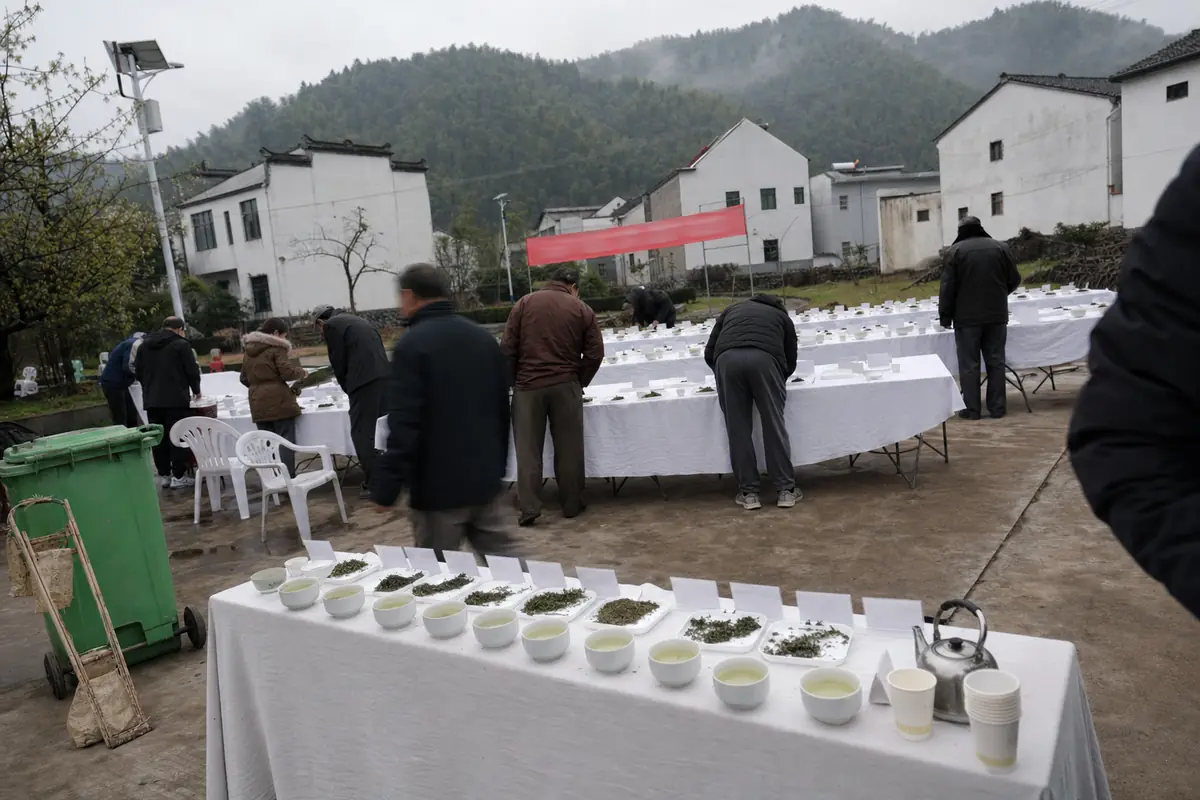
The Tea King contest (茶王赛) is held on the square at Yucun (庾村), the market town below the scenic area gate, and every edition on record fell in mid April. In 2023 six expert judges scored each sample on dry leaf, liquor, aroma, taste and spent leaf, while at public tables round them local tea drinkers and visitors tasted and voted.
The field is modest: nearly 20 producers in 2018, 26 in 2023, 15 in 2024. In 2023 the title went to Wang Shiyan, who went back to his family’s farm after university. In 2024 the stalls sold yellow tea ice cream and yellow tea milk tea.
2018, China News Service (中国新闻网), 15 April 2018, tier 2. https://www.chinanews.com.cn/m/cj/2018/04-15/8491576.shtml; 2023, Xinhua (新华网), 20 April 2023, tier 2. http://www.news.cn/local/2023-04/20/c_1129543397.htm; 2024, Deqing News (德清新闻网), 15 April 2024, tier 2. http://dqnews.zjol.com.cn/dqnews/system/2024/04/15/034592331.shtml
The latest we found reported is the 16th, on 14 April 2024. Nothing turned up for 2025 or 2026, and no 2027 date has been published.
Where to drink it and buy it
Reports from 2023 and 2026 name places that serve or sell it. They give no hours or prices, so treat this as a list to ask about, not a timetable.
- Yunhe Shanfang (云鹤山房), a tea and book space at the foot of the mountain in a converted factory, run by Shen Yunhe’s daughter, Shen Chanying (沈婵樱). It sells tea by the gram in small jars; Xinhua said that alone lifted the tea’s price three or four times over.
- Yunzai Hechu (云在何处), a tea café in Hecun village (何村村) beside 38 mu of tea and chestnut trees, which the report says takes up to 300 visitors a day.
- The Guangming tea farm (光明茶场) in Beihu village (北湖村), the 2024 yellow tea winner, which also runs a guesthouse and sells packed tea at the tourist distribution centres (旅游集散中心).
- Haohao bakery (好好面包) in Liaoyuan village (燎原村), whose huangya loaf sold more than 200 a day in summer 2026.
Yunhe Shanfang, Yunzai Hechu and the bakery, Deqing News (德清新闻网), 22 September 2026, tier 2. https://dqnews.zjol.com.cn/dqnews/system/2026/09/22/035296333.shtml; selling by the gram and the Guangming farm, Xinhua (新华网), 20 April 2023, tier 2. http://www.news.cn/local/2023-04/20/c_1129543397.htm
Wherever you buy, ask 黄茶还是绿茶, yellow or green, and the price for 50 g. Then brew it as the tea space Xinhua visited does: a lidded bowl (盖碗), water at 90 °C. The square and its shops are in our Yucun guide; the rest of the mountain is under things to do.
Water at 90 °C in a lidded bowl, Xinhua (新华网), 20 April 2023, tier 2. http://www.news.cn/local/2023-04/20/c_1129543397.htm
Last checked 8 November 2026 by Liyan Ye. Prices, timetables and entry rules on this mountain move without notice, so confirm anything you are booking around.
Photographs on this site are representative illustrations, not documentary images of the specific building, property or service described.