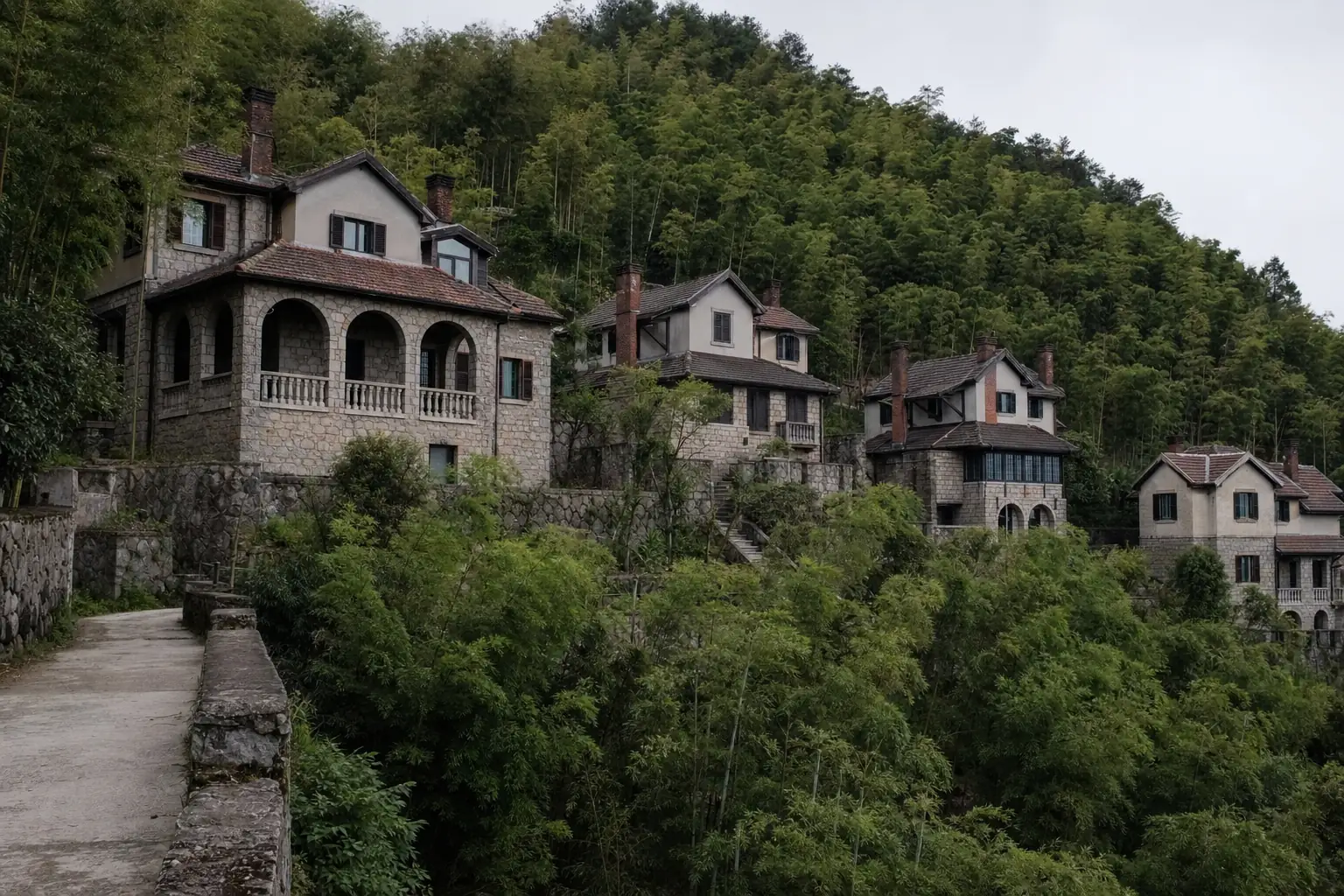
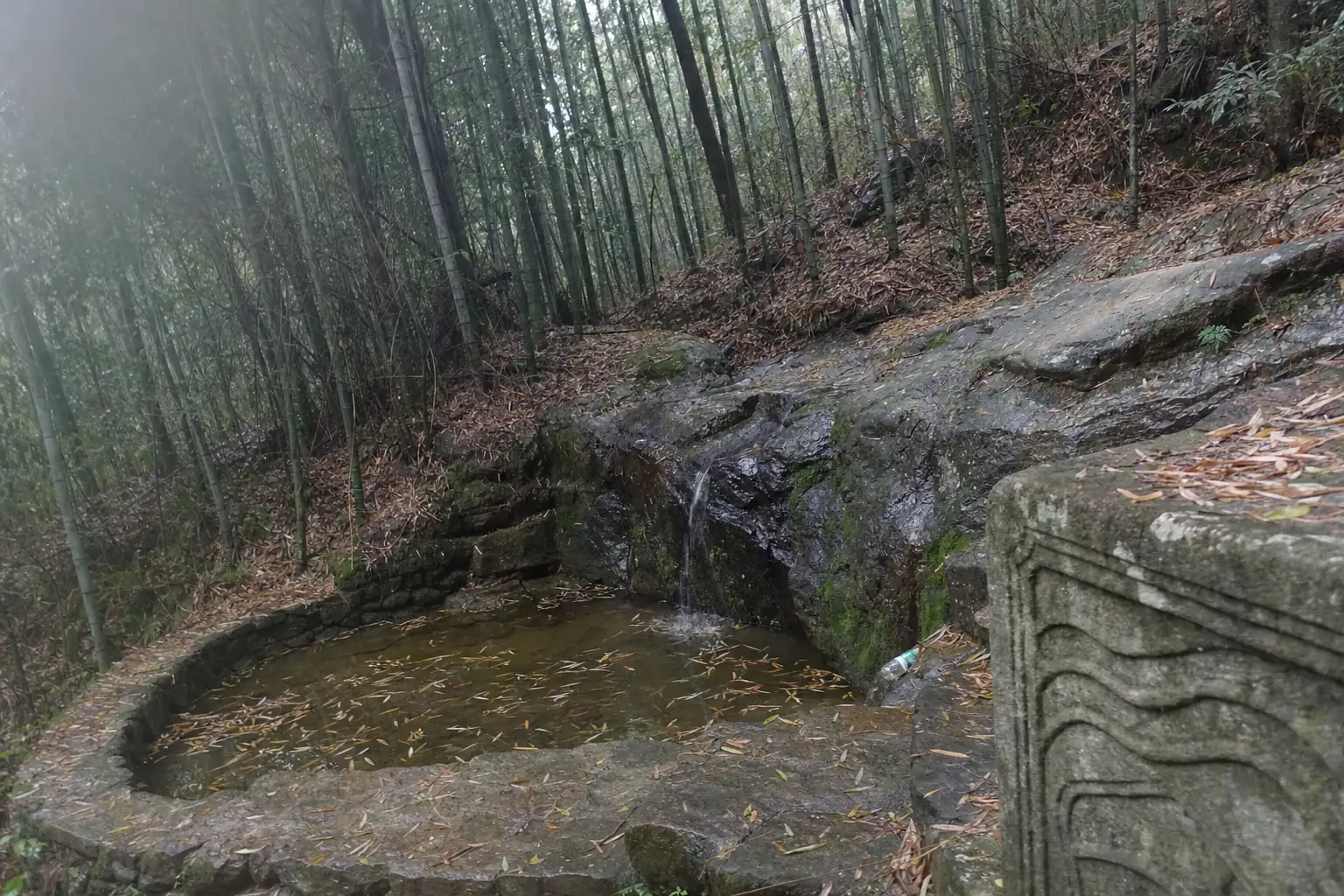
The version a national paper printed in 2013 goes like this. The King of Wu ordered Gan Jiang (干将) to forge a sword here. For three months the metal would not melt, so his wife Mo Ye (莫邪) leapt into the furnace, and the pair of swords was made. The mountain took its name from the two of them.
The fullest early telling of the Gan Jiang and Mo Ye legend says something different. Mo Ye does not jump. Nobody in it is on this mountain. And the early books cannot agree on which king the swords were made for.
Moganshan (莫干山) is in Deqing County, Huzhou, Zhejiang, about 60 km from Hangzhou and 200 to 240 km from Shanghai. Moganshan Road in Shanghai, home of the M50 art district, is a different place. The pool tied to the story, and how to reach it, is on our Sword Pond page. This page is about the texts.
The version told on the mountain, King Helü, three months and Mo Ye leaping into the furnace, Guangming Daily Digest (光明日报 文摘报), 3 August 2013, tier 2. https://epaper.gmw.cn/wzb/html/2013-08/03/nw.D110000wzb_20130803_2-07.htm
The Gan Jiang and Mo Ye legend, source by source
| Source | When written | Whose sword | Does it name Moganshan |
|---|---|---|---|
| Xunzi (荀子) | Warring States | King Helü of Wu, names of swords only | No |
| Yuejue shu (越绝书) | Eastern Han | The King of Chu, with Ou Ye Zi | No |
| Wu Yue Chunqiu (吴越春秋) | Eastern Han | King Helü of Wu | No |
| Lie shi zhuan (列士传) | Han, read today in a Song quotation | The lord of Jin | No |
| Soushen ji (搜神记) | Jin | The King of Chu | No |
| Song gazetteer, as quoted by Zhu Wei | about 1201 | “The King of Wu” | Yes, a casting pool and a whetstone |
The first five are texts we read ourselves, in the Wikisource editions cited below. The last we know only through a modern writer’s quotation, and the section on the mountain says so.
The oldest mention: two names for swords
In the earliest text we read, Gan Jiang and Mo Ye are swords, not people. The philosopher Xunzi lists them in his chapter on human nature: “Helü’s Gan Jiang, Mo Ye, Juque and Pilü, these were all fine swords of old.” His point is that even these will not cut without a whetstone. Nobody forges anything in the passage, and nobody has a wife.
“阖闾之干将、莫邪、钜阙、辟闾,此皆古之良剑也”, Xunzi (荀子), the chapter on human nature (性恶), Warring States, read in the Wikisource edition on 4 November 2026, tier 2. https://zh.wikisource.org/zh-hans/%E8%8D%80%E5%AD%90/%E6%80%A7%E6%83%A1%E7%AF%87
The fullest early telling: hair, nails and 300 children
The fullest early version comes from the Wu Yue Chunqiu (吴越春秋), a history of the two southern rival states written by Zhao Ye (赵晔) in the Eastern Han. Here Gan Jiang is a man of Wu who trained under the same master as the smith Ou Ye Zi (欧冶子). King Helü (阖闾) wants two swords.
Gan Jiang gathers the finest iron of five mountains. For three months the metal will not run. Then he remembers his teacher. When the teacher’s metal would not melt, he says, “husband and wife both went into the furnace”, and the work was done.
Mo Ye answers him. If the master could melt himself to make the thing, she asks, why should it be hard for her? Then she cuts off her hair and her nails and throws them into the fire. Three hundred girls and boys work the bellows and feed the charcoal, and the metal flows.
So the leap into the furnace belongs to the teacher’s generation. In this text Mo Ye gives her hair and nails, not her body.
The two swords are named for the couple: the yang sword Gan Jiang, with a tortoiseshell pattern, the yin sword Mo Ye, with a watered pattern. Gan Jiang hides the yang sword and gives the king the yin one. The story then turns on the sword itself. An envoy from Lu, shown it, finds a notch “the size of a grain of millet” in its edge and refuses the gift.
Mo Ye cuts her hair and nails (断发剪爪), three hundred girls and boys at the bellows, the yang and yin swords, the hidden blade, Zhao Ye (赵晔), Wu Yue Chunqiu (吴越春秋), the Helü chapter (阖闾内传), Eastern Han, read in the Wikisource edition on 4 November 2026, tier 2. https://zh.wikisource.org/zh-hans/%E5%90%B3%E8%B6%8A%E6%98%A5%E7%A7%8B/%E9%97%94%E9%96%AD%E5%85%A7%E5%82%B3
Three kings for one couple
The other early books move the couple between courts.
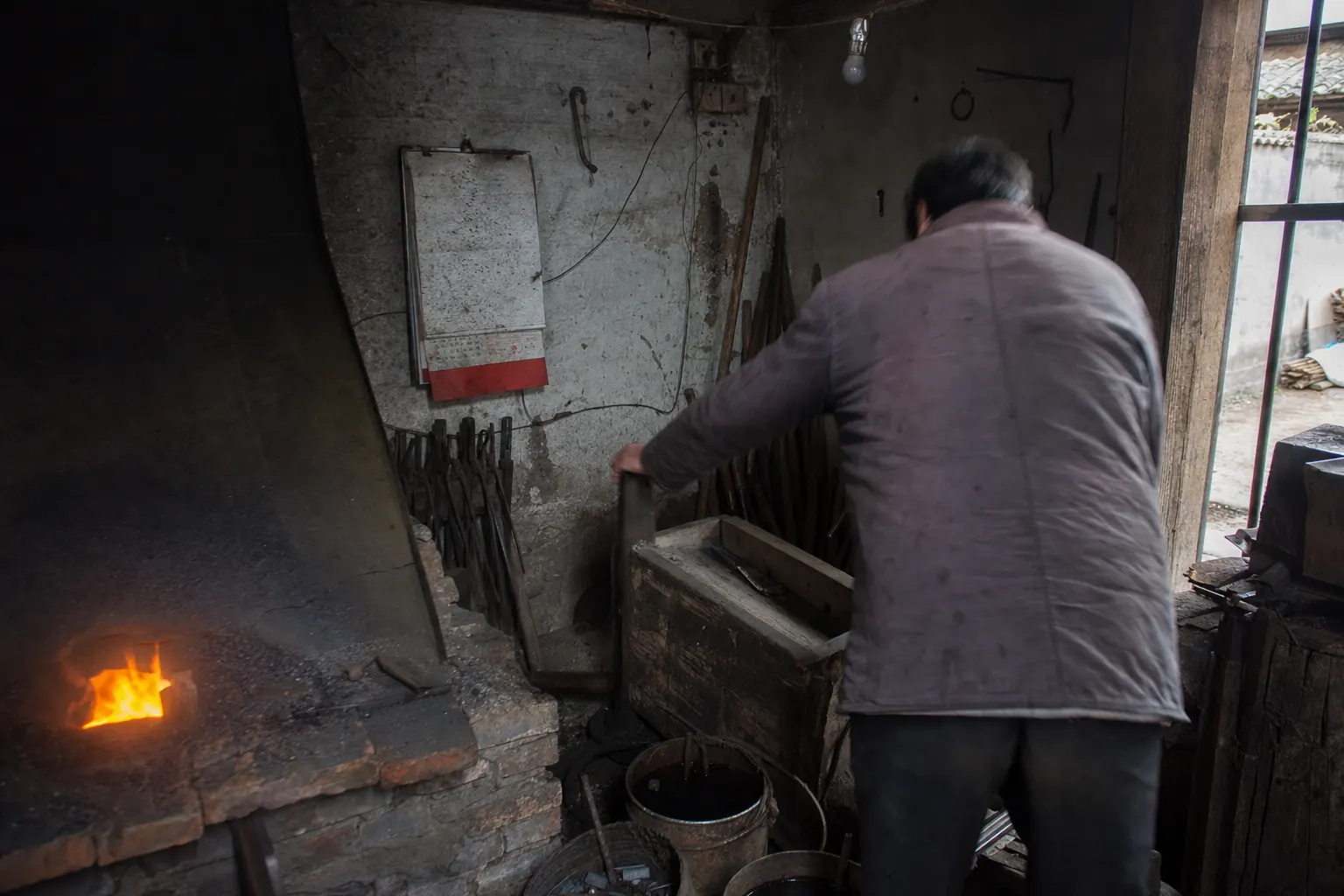
The Yuejue shu (越绝书) has the King of Chu send his minister Feng Huzi (风胡子) to Wu to hire two smiths, Ou Ye Zi and Gan Jiang. They cut into a mountain, drain its stream, take the iron and make three swords. Mo Ye is not there at all.
The Lie shi zhuan (列士传), a Han collection that Zhu Wei (朱炜), writing for the Huzhou city publicity account, attributes to Liu Xiang (刘向), is read today in the quotations of a Song encyclopedia. In it the couple forge for the lord of Jin. It takes three years. Gan Jiang keeps the male sword, hides it and is killed; his son grows up to avenge him.
“干将、莫耶为晋君作剑,三年而成”, the Lie shi zhuan (列士传) as quoted in the Taiping yulan (太平御览), book 343, read in the Wikisource edition on 4 November 2026, tier 2. https://zh.wikisource.org/zh-hans/%E5%A4%AA%E5%B9%B3%E5%BE%A1%E8%A6%BD/0343
Feng Huzi, Ou Ye Zi and Gan Jiang, three iron swords for the King of Chu, Yuejue shu (越绝书), book 11, Eastern Han, read in the Wikisource edition on 4 November 2026, tier 2. https://zh.wikisource.org/zh-hans/%E8%B6%8A%E7%B5%95%E6%9B%B8/%E5%8D%B7%E5%8D%81%E4%B8%80
The Soushen ji (搜神记), Gan Bao’s (干宝) Jin dynasty book of strange tales, gives the fullest version of the revenge. The couple forge for the King of Chu. The sword takes three years, the king is angry, and Gan Jiang knows he will die. He tells his pregnant wife where the male sword is hidden: “go out of the door, look to the southern hill, a pine grows on a stone, the sword is at its back.” It turns out to be the pine pillar of their own house.
Their son is Chi (赤), the boy the king sees in a dream with “a foot between the brows”. He cuts off his own head and gives it with the sword to a stranger who has promised revenge. The head boils for three days without softening. When the king leans over the cauldron, the stranger strikes off his head, then his own, and the three heads boil together past telling apart. The text puts their shared grave, the Tomb of the Three Kings (三王墓), in Runan (汝南), a long way from Deqing.
The King of Chu, the hidden sword, the son Chi and the three heads, Gan Bao (干宝), Soushen ji (搜神记), book 11, Jin, read in the Wikisource edition on 4 November 2026, tier 2. https://zh.wikisource.org/zh-hans/%E6%90%9C%E7%A5%9E%E8%A8%98/%E7%AC%AC11%E5%8D%B7
This is the story Lu Xun (鲁迅) rewrote as his short story Forging the Swords (铸剑), published in 1927.
Lu Xun’s story drawn from the Soushen ji, published in 1927, Guangming Daily Digest (光明日报 文摘报), 3 August 2013, tier 2. https://epaper.gmw.cn/wzb/html/2013-08/03/nw.D110000wzb_20130803_2-07.htm
When the mountain joined the story
None of these texts names Moganshan. The one mountain named, in the Yuejue shu, is Cishan (茨山), and nothing in the text puts it in Deqing. The Wu Yue Chunqiu says only that, ever since the teacher’s sacrifice, smiths have gone to a mountain to smelt, dressed in mourning hemp. Every early version is a story about kings and swords, not about this county.
The link appears in local records much later. Zhu Wei quotes a Song gazetteer of the Jiatai years (1201 to 1204), the Wuxing zhi (吴兴志), which cites an earlier record, the Yuying zhi (余英志). It says the mountain “has a sword casting pool, its water always clear”, with a whetstone beside it, “handed down as the place where the King of Wu cast swords”. The line names a king of Wu but not the couple. We have not read the gazetteer itself; the quotation is his.
The Song gazetteer line on the casting pool and whetstone, quoted by Zhu Wei (朱炜), Huzhou Release (湖州发布) on The Paper (澎湃新闻), 25 January 2025, tier 4, as the city’s publicity account published it. https://m.thepaper.cn/newsDetail_forward_30032404
The city government’s own account, published in 2008, has the couple and the name together. Its local version blends the two early stories. A king of Wu gives the couple three months. Mo Ye cuts her nails and hair, kneads them with yellow earth into the shape of a person and throws that into the furnace. The blades are quenched in the mountain spring and ground on the mountain’s stone. The revenge plot of the Soushen ji follows, moved to Wu, and “later people” name the pool Sword Pond and the mountain Moganshan.
The local version and the naming, Huzhou Municipal People’s Government (湖州市人民政府), “The origin of the name Moganshan”, 19 November 2008, tier 1, as the city’s published account of a legend. http://custom.huzhou.gov.cn/hzgov/front/s678/dawh/rwls/dgp/20081119/i3926548.html
Why Mo comes before Gan in the name, none of the early texts says. A 2019 People’s Daily feature gives one local explanation: later people put Mo Ye’s name first out of admiration for her.
Mo Ye’s name put first, People’s Weekly (人民周刊), 17 October 2019, tier 2. https://paper.people.com.cn/rmzk/html/2019-10/17/content_1950964.htm
What the mountain added
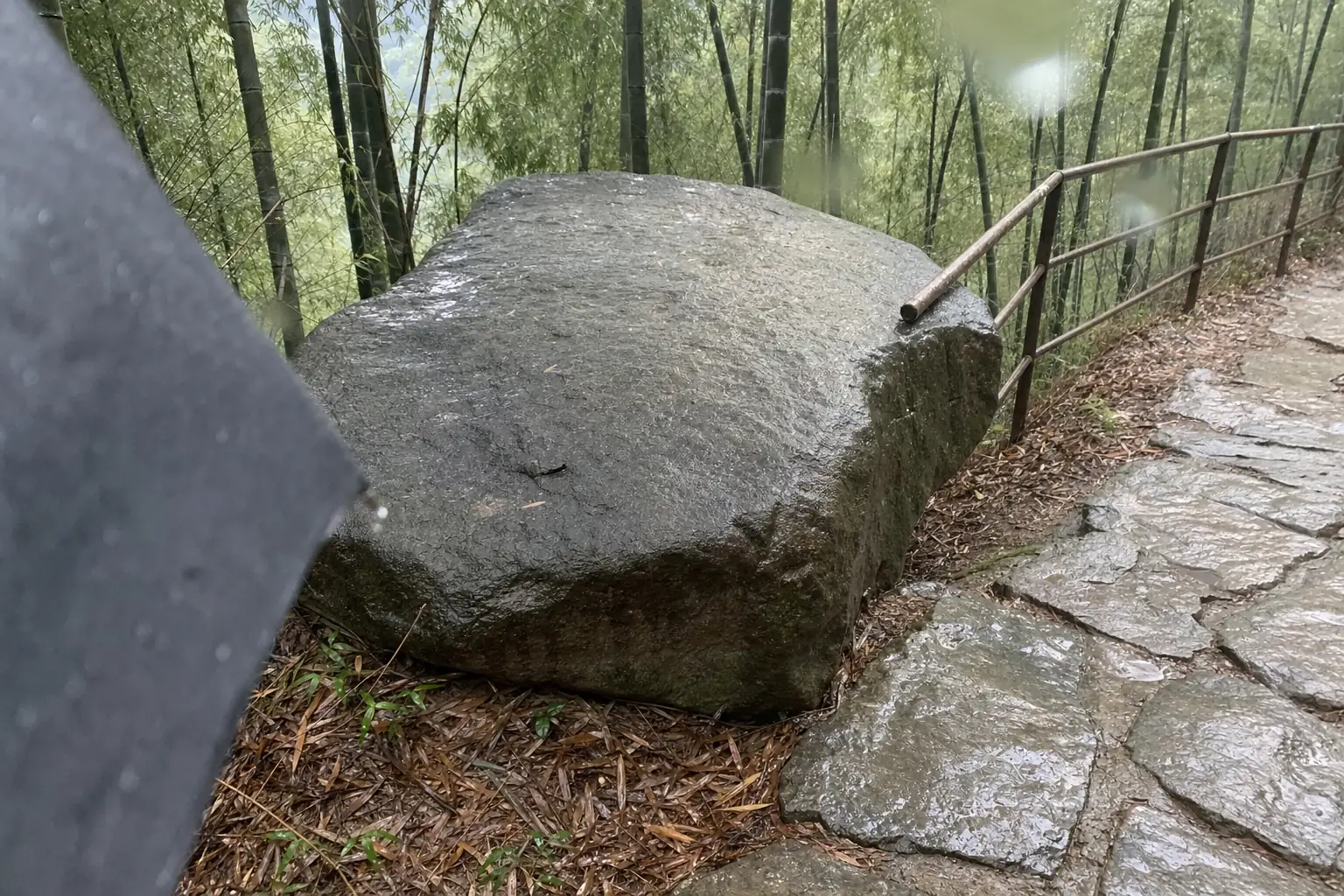
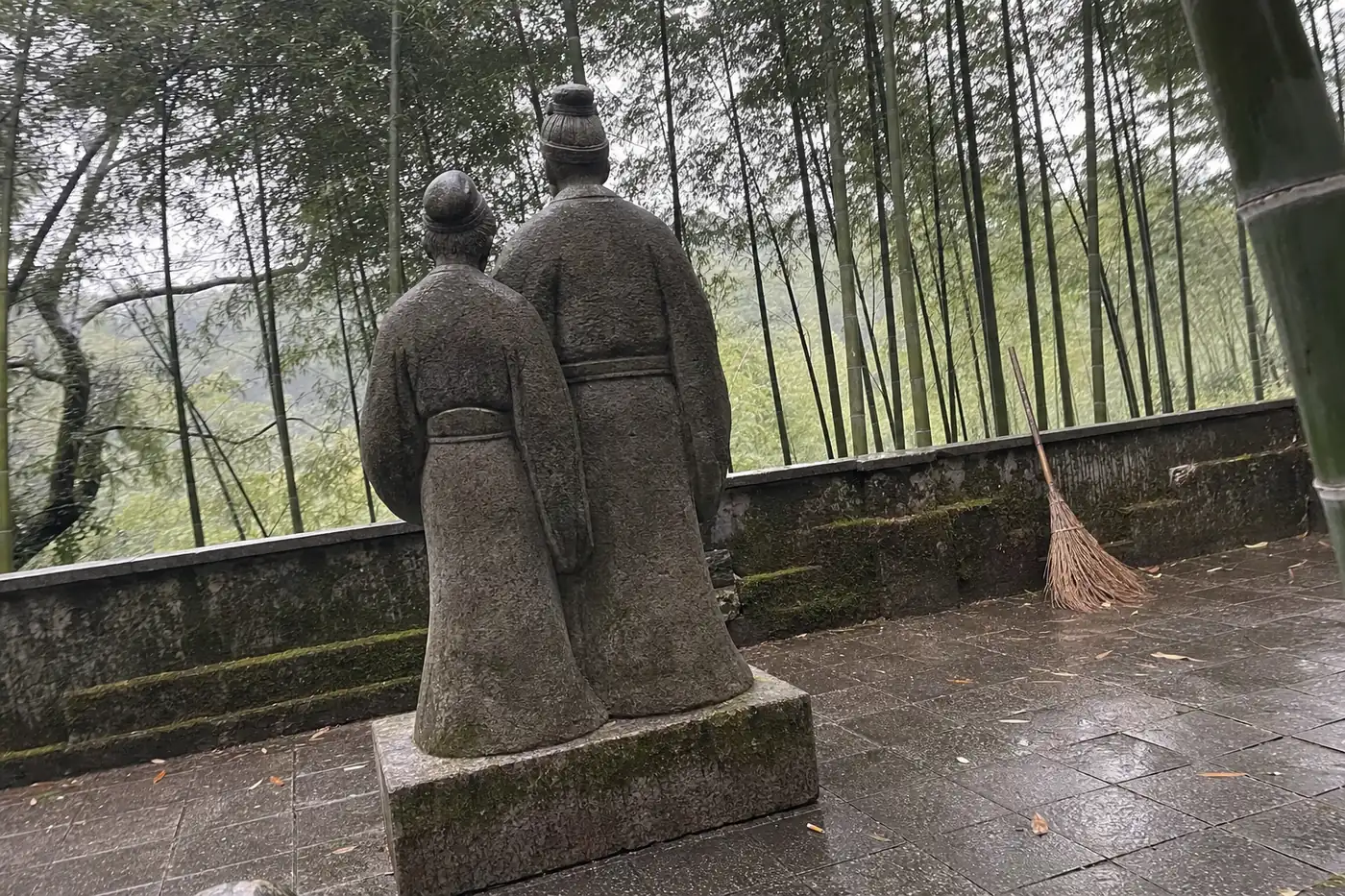
Once the story arrived, the mountain filled it with places. Zhu Wei lists a “King of Wu’s sword pit” at Luhuadang (芦花荡), Moganwu village (莫干坞) as Mo Ye’s birthplace, and Biwu (碧坞) as the valley where mother and son hid. In the local tellings Gan Jiang becomes a man from the Wukang hills, and the son is called Mogan. They were written down by local writers in the 1980s and 1990s and printed in the Zhejiang volume of the national folk tale collection in 1997. Zhu Wei also writes that the management bureau set a statue of the couple above the pond after the 1984 conference on the mountain.
Local place names, the Wukang Gan Jiang, the son Mogan, the folk tale collections and the statue, Zhu Wei (朱炜), Huzhou Release (湖州发布) on The Paper (澎湃新闻), 25 January 2025, tier 4, as published. https://m.thepaper.cn/newsDetail_forward_30032404
The mountain also gave Mo Ye a father. On a platform at Luhuadang stands a statue of Mo Yuan (莫元) and his daughter. In the local story he fled a sickness by Lake Tai, named the girl Mo Ye to ward it off, and settled here, where she met a young smith called Gan Jiang.
Mo Yuan and Mo Ye, and the statue at Luhuadang, People’s Weekly (人民周刊), 17 October 2019, tier 2. https://paper.people.com.cn/rmzk/html/2019-10/17/content_1950964.htm
None of these places is in any of the early texts. The Biwu Dragon Pool page has one more of them: a 2021 account ties that pool to the couple too.
Reading it at the pond
Stand at Sword Pond with two things in mind. A casting pool on the mountain is in the Song record, and the statue is modern. The legend itself is older than either by more than a thousand years, and it was told about other courts first.
None of this takes anything from the walk. Mao Zedong stopped at the whetstone in March 1954, by the account of the people with him; the stone was already the legend’s landmark then. Our history of the hill station picks up where the recorded town begins, in the 1890s.
Mao at the whetstone in March 1954, Guangming Daily Digest (光明日报 文摘报), 3 August 2013, tier 2. https://epaper.gmw.cn/wzb/html/2013-08/03/nw.D110000wzb_20130803_2-07.htm
If you read Chinese, the Wu Yue Chunqiu passage is short and worth having on your phone at the water. If you do not, the order of events above is the fullest early one on record: hair and nails, 300 children at the bellows, and the yin sword given to a king of Wu while the yang stayed hidden. If you came for the walk rather than the texts, the Sword Pond page has everything you need.
Last checked 5 November 2026 by Cyril Drouin. Prices, timetables and entry rules on this mountain move without notice, so confirm anything you are booking around.
Photographs on this site are representative illustrations, not documentary images of the specific building, property or service described.